28 Jul 2026
I watched Elon Musk's interview with Zanny Minton Beddoes of The Economist. What a lovely chap.
I watched Elon Musk's interview with Zanny Minton Beddoes of The Economist. What a lovely chap.
Apparently, within ten years we won't need money, because AI and humanoid robots will provide for everything we need.
It is a rich claim from the wealthiest man alive, and it skips a somewhat important step. Economics usually runs like this: I make something or provide a service, and somebody buys it. If nobody needs money, why would any person or business make anything at all, whether that is a robot, a model or a meal?
His other large idea, which he has mentioned before, is space data centres.
Putting them in orbit solves last year's bottleneck. The pitch has obvious appeal, since Earth is running short of power, land and water, while orbit offers abundant sunlight, room to expand and no planning committee debating your substation or destruction of wetlands and so on.
AI demand is expected to absorb around 60% of TSMC's (leading chip maker) leading-edge capacity this year and roughly 86% next. You cannot launch chips that have not been fabricated, and orbit is a demanding place to send the ones you do have. A terrestrial cluster can be repaired, while an orbital one cannot, so it needs roughly 20% more hardware provisioned as redundancy, consuming even more of the resource already in shortest supply.
SemiAnalysis estimates a current-generation cluster at $8.64 per GPU-hour in orbit against $2.37 on Earth, rising to $10.91 against $2.49 once radiation failures, downtime and redundancy are included. You are paying more to launch it, replace it three times faster than a building, and insure against never touching it again.
One billion tokens of orbital inference comes to $590, compared with $135 on Earth, and that difference will eventually reach someone's invoice. It makes Fable look rather cheap by comparison.
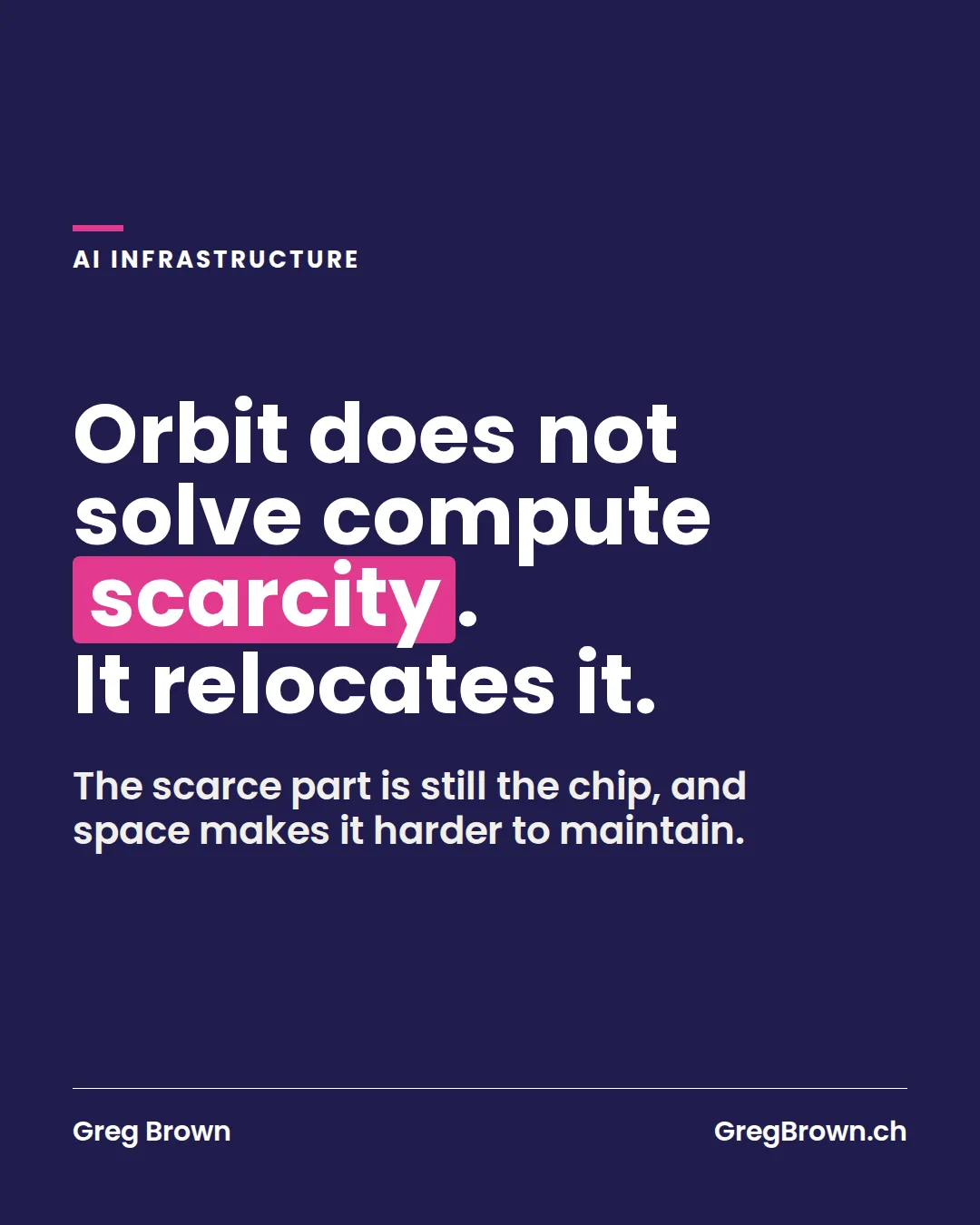
None of this makes the idea absurd. Orbital compute is a hedge against a world where terrestrial expansion is blocked by seven-year grid queues and planning refusals, and on current modelling, cost parity arrives around 2040. For now it takes the scarce part of the system, makes it harder to maintain, and launches it somewhere nobody can reach.
So for now we are stuck with the data centres we have, and it would be better to invest in making them cheaper to power and cool, as well as lessening their environmental impact, rather than in launching them.
Originally published on LinkedIn
Want to apply this to your business?
If this sparked a useful question, let’s talk about where AI, automation, or product strategy can create practical leverage in your organisation.
Start the conversation