29 Jun 2026
Judgement or theatre: the false AI-adoption binary (blurred screenshots, evergreen). Give daylight from the practitioner pair.
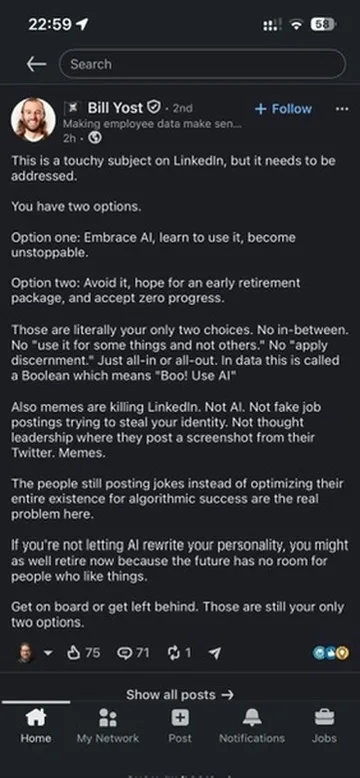
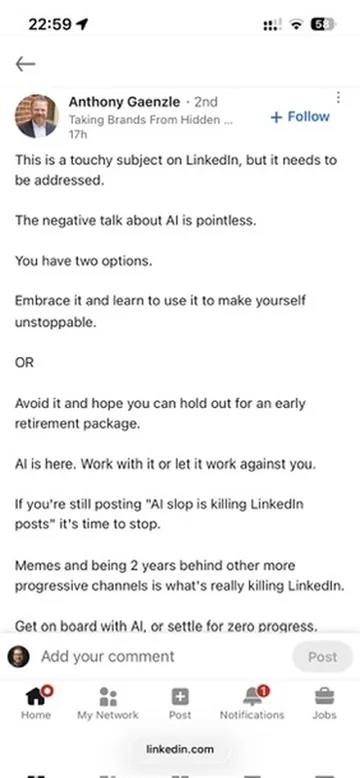
I saw these two posts, and the second one made the first one clearer.
The first is the familiar AI adoption binary: embrace AI and become unstoppable, or avoid it and get left behind. Work with it, or let it work against you. Get on board, or accept zero progress. Whilst the second pokes fun at exactly why that framing is so weak.
Because those are not the only two options in AI.
There is a rather large space between ignoring AI completely and handing your judgement over to it like a set of house keys. You can use the tools heavily and still think most AI slop is bad. You can build with AI and still criticise lazy automation. You can be serious about adoption and still ask whether a given use case actually improves the work.
The useful divide is not between people who use AI and people who do not.
It is between people who use it with judgement and people who outsource their judgement to it.
AI is not a religion. It is not a personality. It is not a replacement for taste, context, responsibility or knowing when the answer is nonsense in a clean suit. Use it to draft, test, analyse, code and challenge, wherever it makes the work better or faster. But also know when not to use it: when the output is too thin, the tone is off, the source matters, or the risk is too high for “the model sounded confident” to suffice.
That is the part many of the loudest AI adoption posts skip. They talk about usage as if it were progress itself. More prompts. More tools. More automation. More "get on board". But adoption without discernment is not transformation. It is just motion.
The future does not belong to people who blindly embrace AI. It belongs to people who can tell where it helps, where it fails, and where a human still has to carry the responsibility.
The real choice is not whether you use AI. It is whether you still know when not to.
Originally published on LinkedIn
Want to apply this to your business?
If this sparked a useful question, let’s talk about where AI, automation, or product strategy can create practical leverage in your organisation.
Start the conversation