04 May 2026
GitHub revealed how much AI models actually cost to run.
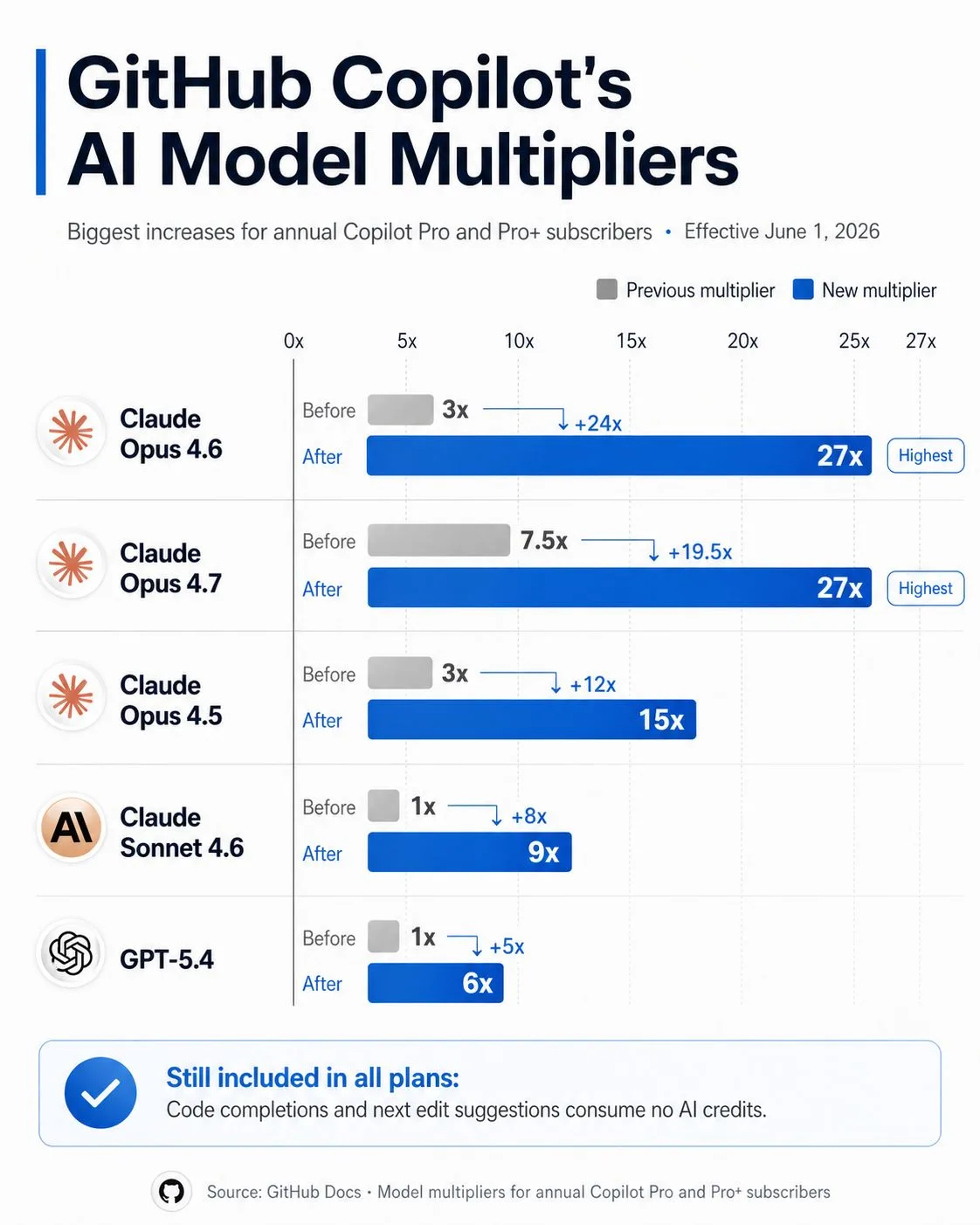
GitHub just revealed how much AI models actually cost to run. And it changes how you should think about AI budgets.
From 1 June, GitHub Copilot is moving from flat-fee billing to usage-based pricing. Instead of paying a fixed monthly rate and using whatever you like, every interaction now consumes tokens, and every token has a price that depends on which model you choose.
**That makes the economics much more visible. **
Claude Opus 4.6 jumps from 3x to 27x. GPT-5.4 goes from 1x to 6x. That does not mean those models are 27- or 6-times better. It means they are dramatically more expensive to use. See the infographic for an overview.
This is a pricing signal, not a capability signal. A low multiplier means a cheaper model and more room to use it freely. A high multiplier means heavier compute and faster credit burn. Pick the wrong model for a routine task, and your allowance disappears a lot faster than you expect.
GitHub has also paused new individual plan sign-ups and tightened weekly usage limits, citing the compute demands of agentic coding sessions. Anthropic has also implemented reduced usage.
This is not just a GitHub story. It is a preview of where all AI pricing is heading.
Right now, most AI products still feel like flat-fee magic. Pay the subscription, use the tool, don’t think too hard about the cost underneath. But the economics have always been usage-based. Every prompt consumes compute. Every response consumes tokens. Every model has a different cost per unit of work.
GitHub is simply making that visible earlier and more explicitly than most.
If your business is budgeting for AI as though it were a fixed monthly software cost, this is the moment to revisit that assumption.
Want to apply this to your business?
If this sparked a useful question, let’s talk about where AI, automation, or product strategy can create practical leverage in your organisation.
Start the conversation