18 May 2026
Why everyone in AI keeps talking about compute, and what it actually means for your business
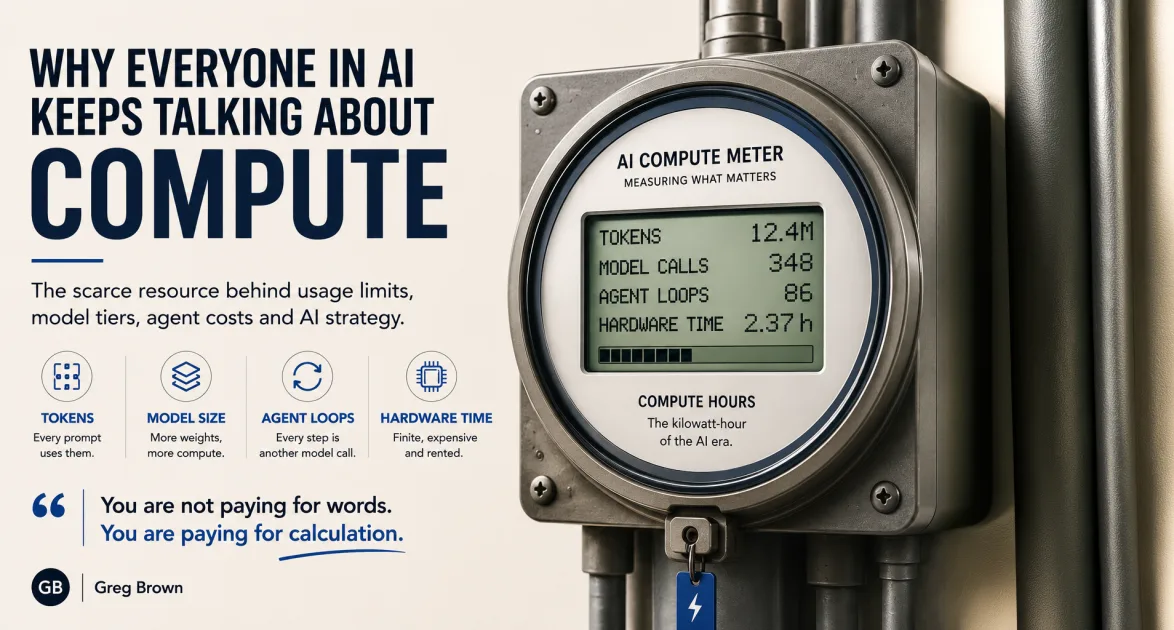
Understanding AI Compute: Why Your Bill Works the Way It Does
Your usage limit shrank this month, and then it may have increased again. The reasoning model costs five times as much as the fast one. Managed Agents are priced per session-hour rather than per token. None of this is arbitrary. It all routes back to the same thing: compute.
If you've spent any time around AI in the last two years, you've heard the word compute thrown around in a way that suggests it explains everything. It nearly does. Once you see how compute works as a resource, a lot of confusing market behaviour suddenly makes sense, including most of what you're feeling on your own AI bill.
Here's the whole thing in plain terms, and what it means for the decisions an SME owner has to make this year.
What "compute" actually is
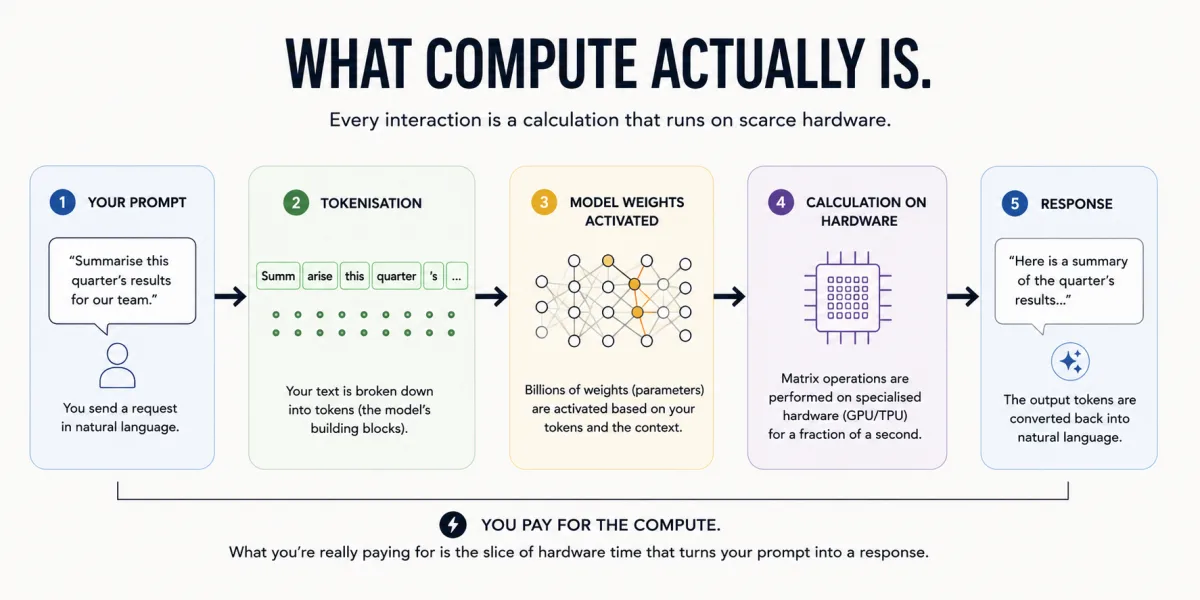
Every interaction you have with an AI model is a calculation. A very large calculation, involving billions of weights, is performed on specialised hardware optimised for the kind of parallel maths that neural networks require. That hardware is finite, expensive, and rented by the second.
A word on weights. Think of a model as billions of tiny dials, each one tuned during training to encode what the model has learned. A "70 billion parameter" model has exactly that many dials. Every prompt passes through them, which is why bigger models require more compute.
When you send a prompt to Claude or ChatGPT or Gemini, you're not really paying for the words. You're paying for the slice of compute that turns your words into a response. Tokens are how that compute gets measured and billed, but the underlying scarce resource is the hardware time itself.
The closest everyday analogy is electricity. You don't pay for "having lights." You pay for kilowatt-hours consumed. Compute is the kilowatt-hour of the AI era.
Why do some queries cost far more than others?
Not all compute is spent equally. A fast model summarising an email burns a small slice. A reasoning model working through a multi-step problem can burn fifty to a hundred times more, because it's effectively talking to itself between your prompt and its answer.
This is why every major vendor now has tiers:
- Speed-focused: Haiku, Flash, mini
- Balanced: Sonnet, Pro, standard
- Reasoning-heavy: Opus, Reasoning models
The cheap models are cheap because they're either smaller (fewer weights to compute) or run a single pass before answering. The expensive ones think before they speak, and thinking costs compute.
The practical implication is the one I keep coming back to: don't use a reasoning model to summarise a meeting note. You're paying frontier-model prices for fast-model work. Match the model to the job.
The agent multiplier
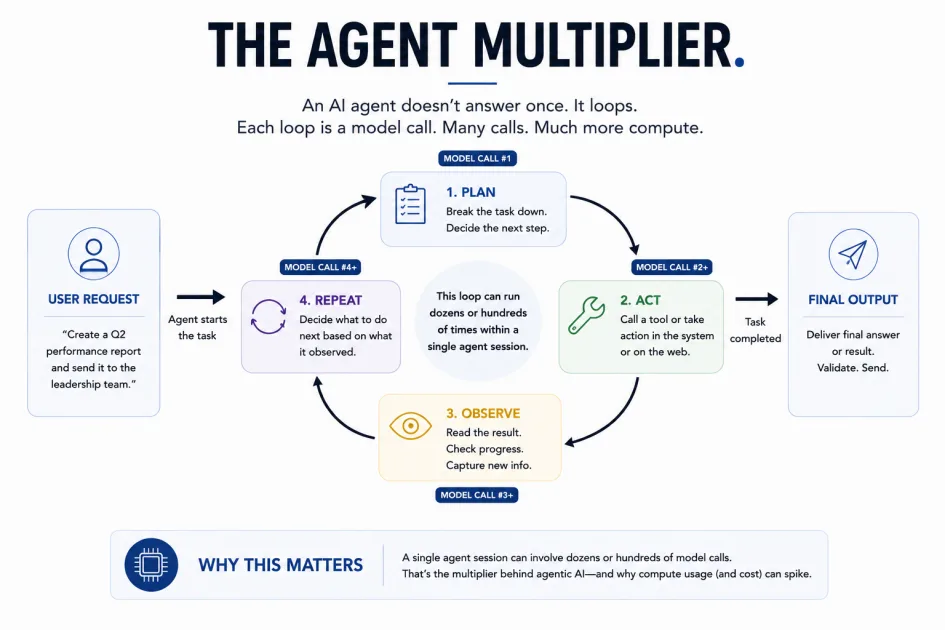
Now compound that. An AI agent doesn't answer once. It loops. Read the task, plan, call a tool, read the result, decide what to do next, call another tool, check the output, write a response, and validate the response. Each step is a model call. Each model call consumes compute.
A single agent session can run dozens or hundreds of these loops. This is why Managed Agents launched at $0.08 per session-hour on top of token costs, and why your bills suddenly look different the moment you graduate from chat to automation. You haven't gone from one query to ten. You've gone from one query to several hundred.
The agentic shift everyone is excited about is also the compute shift. They're the same trend.
Compute as a business risk, not just a cost
Here's where it stops being abstract. Compute is finite at the vendor level. There are only so many high-end accelerators in the world, and they're all spoken for. When demand spikes (a viral product launch, a busy quarter, a popular new model), your vendor has three options: throttle you, queue you, or charge more.
You've felt this already if you've noticed usage limits tightening at peak hours, or seen your favourite model marked as "experiencing high demand," or watched session quotas appear where they didn't exist before. None of this is malice. It's capacity management.
For a business that has built workflows around AI, this is a procurement question, not a curiosity.
- What are your guaranteed throughput limits?
- What's the SLA when capacity is tight?
- Can you automatically fall back to a different model or vendor?
If your customer support agent depends on a model that goes into "high demand" mode every Friday afternoon, you have a real operational problem, not a hypothetical one.
The strategic question: where should your compute live?
This is the question every business will eventually have to answer.
- Cloud frontier models are the most capable, but they put your compute on someone else's hardware, subject to their pricing, their capacity, and, in many cases, their data handling.
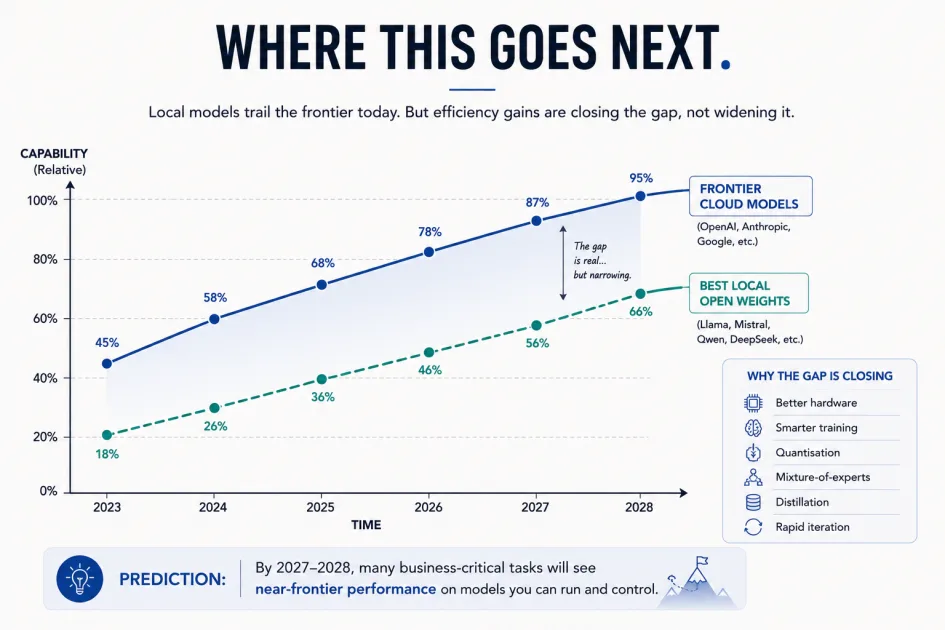
- Locally runnable open-weight models (Llama, Mistral, Qwen, DeepSeek, Gemma) put compute on hardware you control, with predictable costs and no third party in the loop, but they sit a step behind the frontier on raw capability.
For some workflows, the frontier matters. For others, it really doesn't. A model that classifies inbound emails, redacts personal data, drafts routine replies, or pulls structured information from documents doesn't need to be the smartest thing on earth. It needs to be reliable, predictable, and yours.
The right answer is rarely "all cloud" or "all local." It's a mix, decided on a per-workflow basis.
Where this goes next
Here's the prediction that should shape your three-year thinking. Several efficiency techniques are compounding at once:
- Quantisation: Compresses model weights into lower-precision formats.
- Quantisation-aware training: Closing the gap for low-precision operations.
- Mixture-of-experts (MoE): Activates only a fraction of weights per token.
- Distillation: Producing smaller, high-performance models (Phi, Gemma 3, Qwen).
- Inference-specific silicon: NPUs and Apple's Neural Engine making local inference faster.
Within two to three years, most SME-grade AI workflows will be served by local or hybrid setups, even as frontier cloud models continue to advance for the harder problems.
The geopolitical layer
Let us take a brief detour. Compute is now a national-security input. The US has tightened export controls on advanced chips. China is building its own stack. Europe is racing to secure capacity it doesn't currently have. The hyperscalers are spending hundreds of billions on data centres.
For an SME, the practical exposure is regional. Your vendor's compute may be located somewhere with different data laws, different political stability, and different reliability guarantees. Where compute physically sits, sovereignty issues and cross-border considerations are increasingly matters of procurement.
What to actually do with all this
Four practical takeaways for the rest of this year:
- Match the model to the task. Reasoning models for genuinely hard problems. Fast models for everything else. The right mix saves real money at any scale.
- Budget for agents differently. If you're piloting agentic workflows, assume each meaningful task costs ten to a hundred times what a one-shot query costs. Build that into your business case.
- Treat capacity as a procurement question. Ask your AI vendor what your throughput guarantees look like, what happens at peak load, and what your fallback options are.
- Run a serious local pilot. Pick one workflow where privacy, predictability or cost matters more than raw capability, and try it on an open-weight model running on hardware you control.
Compute is the resource shaping every AI decision being made right now, from your weekly usage limits to the trillion-dollar geopolitics of where the chips are made and who gets them. Understanding it doesn't make you a technologist. It makes you a better buyer.
What's the workflow in your business where matching a model to a task would make the biggest difference?
Want to apply this to your business?
If this sparked a useful question, let’s talk about where AI, automation, or product strategy can create practical leverage in your organisation.
Start the conversation